Outbound is sold to you as a messaging problem, then charges you for a capacity one. Three parts of the motion break before the copy does, and the order is predictable. Which one will stop your team first?
The first month worked. Two people, one list built by hand from conference attendee pages, forty emails a day each, and eleven replies in three weeks, four of which became calls. No data subscription, no hired SDR, nothing beyond a domain, two inboxes and a spreadsheet.
The third month did not. Same two people, same list routine, but the send count was four times higher because a target had been attached to it. Replies still arrived. Fewer reached an inbox anyone could see, and the ones that did sat until Thursday, because the only two people who could answer them were on calls and nobody had cleared their afternoon.
Nothing about the message changed between those months. The volume did. That is the input every guide assumes you solved, and it is why in-house outbound lead generation looks like a messaging problem and behaves like a capacity problem. The part nobody tells you is which of the two arrived first, and how much of the third month was already decided in the first.
What Outbound Is Being Sold As, and What It Is
Search the term and you get a page written by somebody selling the service. One of the strongest results is a list of the seven best outbound agencies, published by an agency that ranks itself first. Another is a seventeen-tool roundup from a company that sells appointment setting, which is a strange thing to read when you own no tools and have no appointments. Each page is competent and stops where your decision starts. That is what happens when the person explaining a motion is also selling it.
Outbound lead generation is the work of starting the conversation yourself. You pick the account, find the person, make the first contact, and keep going until they answer or tell you to stop. Cold email, cold calling and social are the channels, and outbound prospecting is the daily work that fills them. The motion is everything between the first send and the booked meeting, which is the part almost nobody describes.
Where the line sits between outbound and inbound marketing lead generation, and who should own which half, is answered in demand generation vs lead generation. This page does not restate it. What follows is narrower: what a small team can actually operate, which part breaks first as the numbers rise, and what an agency quote does not tell you.
The Four Parts of the Motion
Every guide to outbound lead generation treats the channel list as the motion. Four functions have to be staffed instead.
Part | What it actually is | What it costs to run | What fails visibly when underfunded |
|---|---|---|---|
List | Named people at named accounts, each with a reason | Research hours or a subscription per seat | Bounces climb, replies come from the wrong people |
Message | The reason a stranger answers, for one segment | Copy time, plus calls that teach you what buyers say | Opens look fine, replies do not arrive |
Sending infrastructure | Authenticated domains, warmup, reputation you own | Domains, inboxes, DNS, weeks of patience | Mail lands in spam or nowhere, no bounce back |
Follow-up discipline | Someone with hours to read every reply same day | A calendar, not a tool | Replies arrive and go cold in a queue nobody owns |
Most teams fund one of these, and it is almost always the message: the cheapest part to show. The other three decide whether it is ever read.

The message has to sound like the people taking the meeting, which is what brand voice guidelines are for.
The list is a function, not a purchase. A narrow list built from conference pages beats a bought file of ten thousand names, and any serious lead generation strategy b2b conversation starts there. The follow-up is the one nobody budgets for, because it does not appear in any tool's feature list.
What Breaks First as Volume Grows
Volume is linear and buyable. Everything that receives it is not.
Deliverability, before the list quality question
Placement drops and the instinct is to blame the list. More often the sending identity is the problem.
Google has required SPF or DKIM, valid forward and reverse DNS, TLS and a spam rate below 0.3% from every sender since 1 February 2024 (Google, Email sender guidelines, 2024). Above 5,000 messages a day, bulk rules add DMARC alignment and one-click unsubscribe. Each check reports as pass or fail in Postmaster Tools, so you read your own verdict before revenue does (Google, Postmaster Tools, 2025). Yahoo adopted the same regime that day (Yahoo, Sender Best Practices, 2024).
Two vendor panels agree on direction. GlockApps measured 41.27% inbox placement at 1,000 to 10,000 emails a month in the first half of 2026, against 54.31% at 50,000 to 200,000 (GlockApps, 2026). The Digital Bloom measured Outlook and Hotmail at 26.77% in early 2025 (The Digital Bloom, 2025). Small senders place worst, and the corporate mailbox is hardest to reach. That is the misdiagnosis in one line: a placement drop reads as a list problem, and the list is often fine.
Reply handling, where most in-house motions actually die
The constraint is a person's day, not a tool. The Bridge Group measured an SDR at 4.1 quality conversations per day across 112 daily activities, with a 3.0 month ramp and 40% annual attrition (The Bridge Group, 2025). That capacity does not move when you raise the send count.
Belkins measured an average reply rate of 0.45% across 7.5 million cold emails sent in 2025, counting replies against total sends (Belkins, 2026 study). The same dataset notes that a 5% rate against openers describes the same campaign. Half the benchmark you compare against may divide by a different number.
Run the arithmetic on your own numbers. Conversations per day divided by your true reply rate gives the daily send count. For a two-person team with a monthly target, that volume usually exceeds what the domain can carry, while the replies exceed what two people can answer in a day.

A reply that waits is lost rather than delayed. Once replies land on a Tuesday and the same two people are on calls until Thursday, the queue has already made the decision for you. Nothing in the message caused that. It is a capacity problem, and it will be reported as a list problem next month.
Run It In-House or Buy It?
Most b2b outbound decisions get made on headcount, the wrong unit.
Line item | Run in-house | Buy from an agency | What the quote leaves out |
|---|---|---|---|
People | One SDR at $80,000 median on-target (Bridge Group, 2025) | Absorbed | The manager above the seat |
Data | Billed per seat, doubles with the second hire (Apollo, 2026) | Bundled | Enrichment after setup |
Sending infrastructure | Domains, inboxes, warmup, monitoring | Bundled | Who owns the domains at exit |
Management | A reporting line at $146,000 median on-target (Bridge Group, 2025) | Absorbed | The difference |
Ramp | 3.0 months of pay before productivity (Bridge Group, 2025) | Runs from day one | Whether it sits in the term |
Minimum term | None | Three to six months typical | The cost of leaving early |
Exit | You keep list, domains and mailboxes | Contract dependent | List ownership and portability |
The Bridge Group's 2025 survey of 351 B2B companies is the only primary anchor here: median SDR on-target earnings of $80,000.
Vendors publish higher: Newlead $103,000 loaded, SalesHive $110,000 to $160,000 (Newlead, 2026; SalesHive, 2026). Against that $80,000 anchor the multiple is 1.3 to 2.0, which no quote shows.
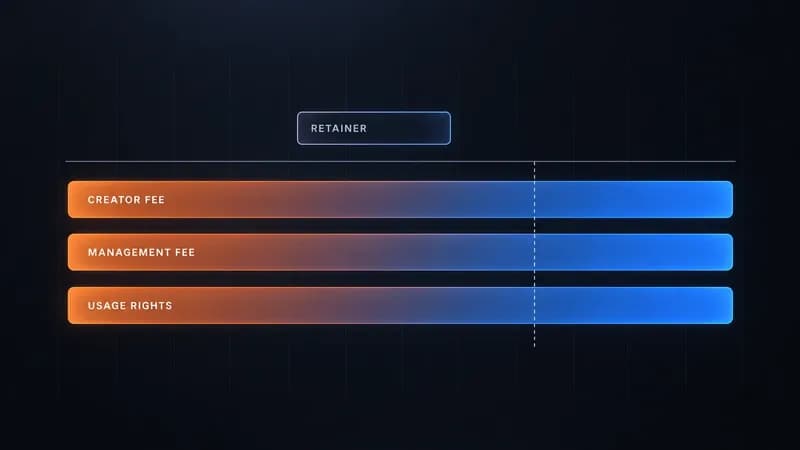
Retainers sit in a band: Bullseye $3,000 to $15,000 a month, Newlead $2,000 to $15,000, SalesHive $2,500 or more (Bullseye, 2025; Newlead, 2026; SalesHive, 2026). All three sell what they price.
The break-even is arithmetic you can run: on-target earnings, the management line, the data seats and the ramp, divided by twelve, against the retainer plus the setup it excludes. If building wins, ask whether follow-up stays staffed past the median 1.9 year tenure (The Bridge Group, 2025), which is why your marketing KPIs must mean the same thing on both sides. Most teams compare a retainer to a salary and stop there, which flatters the agency quote by exactly the costs it absorbed.
The Compliance Floor
Three things can stop you, and they fail differently: law by regulators, platform policy by the platform, admission rules by a machine. The third stops small teams first.
Law
- CAN-SPAM covers commercial email with no B2B exception, requires a valid postal address, and gives 10 business days to honour an opt-out (FTC, 2024).
- The EU basis is usually legitimate interest under Article 6(1)(f), but EDPB guidance is still version 1.0 of a draft adopted 8 October 2024 (EDPB, 2024).
- Germany is reported to require prior express consent for advertising email under UWG Section 7, with no B2B carve-out (BGH, I ZR 201/07, 2009).
- UK PECR excludes corporate subscribers, though sole traders count as individuals, and UK GDPR still covers a named person (ICO, 2024).
Platform policy
- LinkedIn's User Agreement forbids software, scripts or bots that scrape the service or automate adding contacts and sending messages (LinkedIn, section 8.2, 2025). That is a contract term: breaking it restricts an account, not a regulator. No invitation ceiling is published, so any number is an estimate.
Admission rules
- Google and Yahoo sender requirements are neither law nor a contract with the recipient (Google, 2024; Yahoo, 2024). They are delivery conditions, checked automatically and reported as pass or fail.
Conclusion
The order is the lesson. Placement breaks before anyone questions the list, reply handling breaks before the list runs out, and the list runs out last because it is the part you can buy again. Build versus buy follows from one question: which of those three can you staff, and keep staffed through 40% annual attrition (The Bridge Group, 2025)?
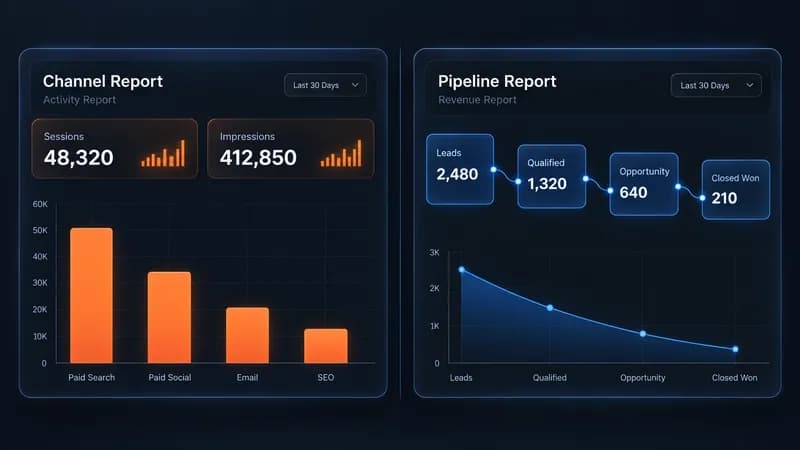
So the first job is measurement. Before you hire or outsource, you need to know which of the three is failing this week. One marketing analytics layer over paid channels, Search Console and the CRM is the difference between a diagnosis and an expensive guess.
Frequently Asked Questions
What is outbound lead generation?
Outbound lead generation is the work of starting the sales conversation yourself instead of waiting for a form. You choose the accounts, find the people, make first contact, and follow up until someone answers. Funding one of the four parts is not a motion.
Is outbound lead generation still worth it in 2026?
Where the list is narrow and reply volume is small enough that a person answers every reply the same day, yes. The Bridge Group measured an SDR at 4.1 quality conversations a day in 2025, so a two-person ceiling is low. It stops being worth it when the plan needs a volume that pushes the spam rate past what Google and Yahoo allow.
How many leads should outbound produce per month?
Whatever the arithmetic gives you. Take the conversations per day your team can handle, divide by your true reply rate, multiply by working days. At 0.45%, the rate Belkins measured against total sends in 2026, one extra conversation a day implies a large jump in sends. Any agency quoting a fixed number is quoting its own campaign average, which is what lead generation marketing agencies price against.

Start with the part that tells you what broke
Placement, reply handling or list: you need those three numbers side by side before you change anything. Allable connects your paid channels, Search Console and your CRM in one workspace, so the failure shows up as a number instead of a feeling. It is the measurement layer for the motion, not an outbound tool. Pro EUR 99, Business EUR 199, Scale EUR 399, each with a 7-day trial.